Previous Notes:
- Declared Heritage of Cultural Interest with rank of Artistic-Historical Monument, on June 3rd, 1931.
- It has gone through several interventions along its history that makes it very difficult to know its original structure; the first of those in 1637, with the replacement of the chevet; later, in the 19th century, the crossing was enlarged and the western façade was rebuilt.
- Excavations in the church had been achieved between 1975 and 1981 and a complete restoration was accomplished directed by José Menéndez-Pidal, with questionable results.
|
|
King Silo (774-783) was the husband of Adosina, who was Froila the First's sister and who died prematurely when his son Alphonse was still too young to succeed. He was elevated to the throne despite the opposition of an important part of the court of Cangas de Onís. Probably because of that and also for the convenience to better locate the capital, centred in the kingdom's teritory, that included Galicia already, he moved the court to Pravia, the old Roman Flavium Avia where he built a set of palaces and a church dedicated to San Juan Apóstol y Evangelista that also seems to have been used as a royal pantheon.
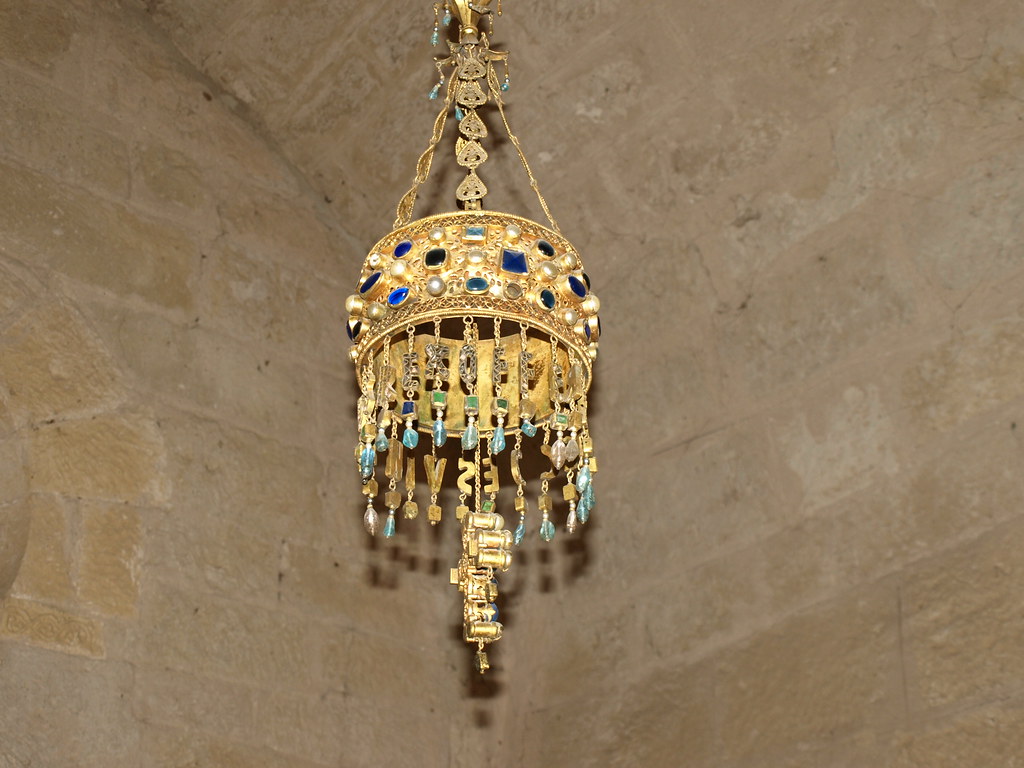
We find references to this church in the chronicles of the times of Alphonse the Third, and a description of its state at the beginnings of the seventeenth century have reached us to day. The sponsorship of this church was stated in a funny acrostic, destroyed in the seventeenth century where the phrase "SILO PRINCEPS FECIT" could be read in a thousand different ways, and that it became a monastery at the death of the monarch. Later it went through several transformations, the first one of them in 1637, where the complete chevet was replaced, and several others in the nineteenth century, when the crossing was enlarged and the western façade was replaced as well. Very few remains of the original construction remained standing at the beginning of the twentieth century. These consisted of some masonry walls and two brick arches at each side of the central nave, upon pillars with bases and imposts decorated with layered fillets. At those times it was studied by Fortunato Selgas, who suggested a probable original structure, and it was investigated between 1975 and 1980 and rebuilt under the supervision of José Menéndez Pidal.
The end result after so many transformations shows us a church of a basilical plan with three naves. The central one twice wider than the aisles and separated from these by a series of three round arches, plastered in brick upon square section pillars with a transept somewhat wider than the naves, also divided in three separated areas by large round arches, the three rectangular plan apses built in the seventeenth century, being the southern one a bit wider than that side of the new transept and a portico also divided in three parts, which central one was used as a royal pantheon, and a tribune upon it. But if we bear in mind the description of the jesuit Luis Alfonso de Carvallo at the beginnings of the seventeenth century and the information obtained from the excavations at the end of the twentieth century, it is unquestionable that there are far too many reasons to believe that there are big differences between one construction, maybe excessively inspired in the churches known of Alphonse the Second's period, half a century later, and its original structure.
Whilst Carvallo described a tripartite chevet though with semicircular apses, only the central one was found in the excavations, which is in fact of the semicircular type, somewhat canted, which location is marked on the floor of the present one. It has been also proven that the original transept was of the same width than the naves, as a continuation of those, so its original plan was most probably formed by a rectangle of almost 25 m long by 13 m wide, divided in six spaces, formed by the three naves; the central one twice the width of the aisles, and a crossing a bit narrower than the main nave, also tripartite, plus a semicircular canted apse as a continuation of the main nave, and a portico, used as a mausoleum of a slightly lower width than the main nave. On the other hand, all the church was covered with wooden roof, except the apse that was probably covered with a porous stone vault, according to the remains found in the last excavations.
Another concept to bear in mind is that all the decoration found is of clear Visigothic influence. The one that was present in churches at the end of the eighteenth century, that today we can find in Cudillero, of a difficult to justify shape, as a great part of the one that appeared in the last excavations. Both the altar formed by a stone plaque upon a strong octogonal pillar, as well as the innerdoors with chiseled decoration on secant circles and friezes with vegetal decorations, as the remains of a window formed by two horse shoe arches framed by a sort of alfiz and leaning upon columns, or the little horseshoe shaped windows that are still preserved in the lateral walls, lead us to think that there are too many Visigothic elements for a church rebuilt with a clear thought on a later period.
But it is still more surprising the existence of a baptismal font at the feet of the southern nave that was found during the latest excavations of Menéndez Pidal. It is a baptistry of the so called immersion baptistries chiseled on a block of sandstone of 60 cm by side and 30 cm deep that, due to its location in the most isolated area of the church, and probably with a direct entrance from the outside, seems to correspond to a Christian rite much older than Silo's times, who did not allow the neophyte its access to the cult until after being baptized. We have to point out also the fact that the chevet's floor, the naves and the baptistry are at different levels, having kept a part of the original one around the baptismal pool, and another one in the baptistry built in Opus Signinum in red, alternating with black pebbles, quite usual in Roman architecture.
According to what we have mentioned above, and starting from the point that both Silo's acrostic as well as the codex of that period back up that the church was built by Silo and his wife Adosinda around 780. We find a series of reliable elements that relate it with the preceeding Spanish architecture as well as with the Asturian art, especiallly with those of Alphonse the Second and Alphonse the Third's reigns:
The semicircular canted apse is very similar to the Basilic of Veranes, at 50 Km from Pavia, and considered to have been built in the fifth or sixth century, because of its shape and for the presence of exterior buttresses. Considering that both are located in two communities of Roman Spain origin, that were inhabited in the Visigothic period, it seems reasonable to think that constructions that previously existed in the area may have had an influence in the initial design of Santianes, of which Veranes is a good example. Apses of this type are also found in previous Spanish churches, like San Bou in Menorca (fifth century), Aljezares in Murcia (sixth century) or Recópolis in Guadalajara (sixth century).
The immersion baptismal font, a system that was not been used in Spain since the sixth century, recalls the existing ones in churches in the peninsula in the fifth and sixth centuries, like San Pedro de Alcántara in Málaga (sixth century), Idanha a Velha in Portugal (sixth century) or Aljezares, and in some basilics in the Balearic Islands although in Santianes it is less deep and there are not the usual seven steps: three to descend; the central one, and three to ascend, according to the description of San Isidoro.
The type of floor found, of a clear Roman or Paleochristian origin has not been utilized in the rest of the known Astur architecture.
All the decoration found both in the church in the nineteenth century as well as in later excavations that conform an undoubtly Visigothic complex.
The remains of the central nave that have been preserved, which are proven to have been built by that king, state a clear precedent of the late Astur architecture, at least in the structure of its naves, but the square pillars are not new in Spanish Pre-Romanesque architecture, with precedents in different periods, as the already mentioned of Son Bou and Aljezares or San Pedro de la Nave in Zamora (seventh century). The round arches in brick were also quite usual in Roman architecture in Spain, and it is possible that there had been constructions with this type of arches in the surroundings of Pravia, for example, in Veranes or in the Flavium Avia, as it seems that the palace complex of Silo was built upon an ancient Roman town.
The rest of what has been found in it, like the present chevet and crosings, the western façade and its tribune and all the elevations of the church, including its presept covering, are later reconstructions which we may consider more or less adequate but its original structure is not guaranteed, since they do not provide reliable information regarding its original state and it may probably generate a wrong idea.
All that has been said confirms Santianes de Pravia as a basic link at the moment of studying the origins of the Asturian art, about which so much has beeen speculated. To do that it is very important to bear in mind the time it was built, a few years later than Carlomagno came to the throne (771) and much earlier than the empire and Carolingian art existed, as well as the lack of communication in those times of the Astur kingdom, since until Silo, its court had been secluded in the mountains in Cangas de Onís. On the other hand, the existence of the complicated acrostic, added to the clear cultural level of Beato de Liébana, that in that very reign was writing his "Comments to the Apocalypse" keeping a theological discussion of great level with Elipando, the Mozarabic bishop of Toledo, lead us to consider that the Asturian kingdom had not been kept unaware of the Roman and Visigothic cultural development in the peninsula. We must also consider that, according to the Chronicles of Sebastian, already in times of Alphonse the First (739-757), many churches had been built and restaured, although nothing of them has been preserved, what makes it unquestionable the continuity of the Visigothic culture in the beginnings of the Asturian art, which, for the time being, until new findings take place, we can only analyse in Santianes de Pravia and Veranes. All of these circumstances of the Asturian kingdom in the times that the church was built, lead us to consider that the fundamental element that Santianes provides to the late Asturian art, which consists on the the utilization of round arches upon pillars in the structure of the naves, must be considered as a leap backwards within the Hispanic building tradition, rather than attributing it to probable external influences.
If we start from that base and bear in mind that, as we have seen, a great amount of the remains preserved from the original construction, have clear precedents in monuments of different phases of the previous Spanish art, we reach the conclusion that we are in front of a building that is the result of the fusion of several heterogeneous elements. In it we find a plan that recalls the basilic structures of the Paleo-Christian type mixed with semicircular casted chevet, three naves with flat roof, portico and baptistry with independent access from the outside, with so dissimilar elements like the round arches in brick upon pillars, similar to those used in Roman architecture; a Visigothic type crossing; the decoration, also Visigothic, that could have been reutilized or developed for the church according to techniques and styles that still prevailed, or the utilization of the portico as a royal mausoleum. All of that makes Santianes de Pravia a clear example of the theory we have exposed in the introduction of this study, in the sense that eclecticism is the funadamental characteristic of all Spanish Pre-Romanesque Art, except during the reigns of Alphonse the Second and Alphonse the Third. In fact this church is already a clear precedent of the later Asturian art, but it had been built prior to the times of Alphonse the Second, when the design of this type of buildings was normalized, utilizing without any prefixed norm both in its structure as in its decoration, different elements that were already available, and out of them, only one, although a basic one, was kept as a fixed characteristic in all the later Asturian art, except in the Ramirense period: the series of round arches upon square pillars.
It is also to bear in mind in this case the possibility that what is considered a new contruction of king Silo could have been the reconstruction of a basilic that already existed from Paleo-Christian times. Though within the assimilation we propose for Santianes of different previous architectural elements, the type of construction and the rest of the mentioned characteristics are prefectly acceptable for a building of the times of king Silo; the presence of a baptismal immersion font is beyond thinking at the end of the eighth century. If on top of that we consider that our church stands in what had been a city of Roman origin that, as Varenes, had been inhabited until then, and the plan structure, so similar to the remains of the church of Varenes, it would be quite logical to think that it could have contained a basilic of a previous period upon which the construction of Silo would have been erected, keeping a great part of the shape of the plan and of the baptismal font. But we are afraid that after so many modifications suffered throughout the centuries it will be very difficult to reach a definite conclusion both on the subject as well as on the original elevations of this church.
Nearest friendly lodgings of Asturian Pre-Romanesque Art |
|
OTHER INFORMATION OF INTEREST
Access: From Oviedo, take A-66 to Gijón for 20Km till A8/E70; continue for 28Km till AS16. Continue for 5.5Km in Pravia to take AS-224. At 1 Km you will find the diversion to Santianes. GPS Coordinates: 43º 30' 7,26"N 6º 5' 57,18"W.
Information Telephone: Tourist office, 985 852 200
Visiting hours; From June 1st through September 30th: Tuesdays through Fridays from 10 to 1:30 and
from 17:00 to 19:30, Saturdays and Sundays: 10:00 to 13:30, Mondays closed. For the rest of the year, make appointment by telephone 985 823 510.
BIBLIOGRAPHY
Arte Pre-románico Asturiano: Antonio Bonet Correa
SUMMA ARTIS: Tomo VIII
L'Art Preroman Hispanique: ZODIAQUE
Ars Hispanie: Tomo II
Arte Asturiano: José Manuel Pita Andrade
Santianes de Pravia
Fortunato de Selgas y la Basílica de Santianes de Pravia
El Proyecto Veranes
Oscar O. Otero: Autobiografía del Rey Silo.
|
| Última actualización: 17-10-2009
|
|