Página creada por Pablo García-Diego. Todos los derechos reservados        SPANISH PRE-ROMANESQUE ART GUIDE
Ver relación de monumentos por Estilo y Fecha Versión en español Versión en francés

General Description

Visigothic

Mozarabic

Altoaragonés


 PHASE II: ASTURIAN PRE-ROMANESQUE ART

  1. INTRODUCTION

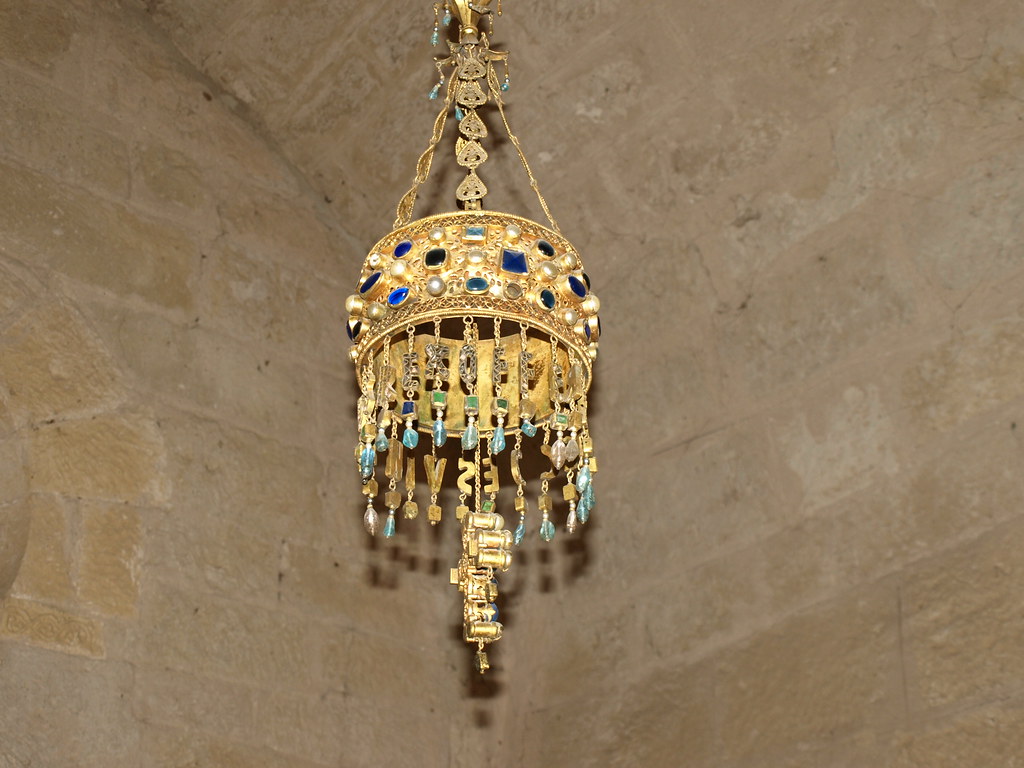
  2. "He established in Oviedo the whole order Cruz de la Victoria. Cámara Santa, Oviedoof the Gothics providing everything, both, for the Church as well as for the Palace, in accordance with what had been followed in Toledo". From our point of view, this sentence by the Albeldense report writer about Alfonso II, el Casto (Alphonse II, The Chaste) who reigned in Asturias for 51 years (791-842) at the beginning of the Reconquest, has now much more importance in the History of Spain than what was thought previously.

    It is important to bear in mind that, during the Visigothic monarchy, the inhabitants of the Iberian peninsula had stopped depending from a foreign power for the first time; that the unification of the whole peninsular territory had been achieved, and that, since Recoredo's conversion to Christianity, there was a good level of social and religious integration, although at the political level there were lots of problems. Everything we know about the new Christian kingdoms indicates that the objective consisted in the reconstruction of that Visigothic monarchy, especially in the case originated in the Picos de Europa from the battle -or better stated, skirmish- of Covadonga. That meant getting rid of the new dependance from a foreign people and the recovery of all territories. The success was clear to the point that if we compare the map of Visigothic Spain at the end of the 7th century with the one of Philip the II's Spain, at the peak of the Spanish empire after nine centuries of reconstruction, we find they are practically identical. In both cases the territory was formed by the whole Iberian peninsula and a very similar part of the south of France.

    When the Arabic invasion took place, the Roman-Hispanics who were used to live for almost a millenium under foreign domination, Covadonga. Cueva de la Virgenadapted themselves to the new situation without much difficulty, since the Arabs treated them with great tolerance, but an important part of the Gothics could flee and find shelter in the mountains of the north forming two resistances , one in Asturias and the other one in Cantabria nucleii with the collaboration of native people that had always shown an independent spirit in front of the successive conquerors of the peninsula. Both nucleii were commanded by the Visigothic nobility mixing almost immediately by marriage to create the Asturian monarchy. This monarchy defined itself from the very beginning as a continuation of the Visigothic monarchy which, in the early stages, was an elective monarchy, placing always in the throne people with a genealogy not always proven, like descendants of the royal Visigothic families. Along with the same objective, a great effort was made to reestablish the social, religious and administrative structures, as mentioned in the Cronicón, that existed in the disappeared Visigothic kingdom; for instance, the same system of distribution of reconquered land that did not have any owners was maintained, something that had a great influence in all the social and political Spanish organisation in later years. It will be basic to keep in mind this vocation of continuity, that was the base of the Asturian monarchy, at the moment of analysing the characteristics of the art that developped during the first two centuries of the Reconquest.

    Within this continuous process of Reconquest, that is, the recovery of all the territories that had been taken over by the Arabic invasion, it is considered as Pre-Romanesque Asturian Art,San Salvador de Priesca. Detalle del ábside central the whole collection of artistic manifestations that took place between 722 (unconfirmed date of the Battle of Covadonga) and 910 when, after Alfonso III el Magno dies, his son Ordoño the II moves the court to León. On this date already a new artistic movement has appeared, the so called "Mozarabic Art", generated by Christians that had lived in Arab territories, begin to migrate to the reconquered zones, bringing along with them an important body of artistic and technical knowledge learnt in Al-Andalus, together with a renewed Visigothic spirit that they had kept alive during the 200 years of domination.

    Along these two centuries, the small kingdom that took up the most rugged part of the Picos de Europa started to spread out throughout all of Asturias and Cantabria first, and then throughout Galicia, which acquired great importance on account of the "invention" of the Apostle St. Jacques' sepulchre and the beginning of the legend of "Santiago Matamoros" (Jacques, the killer of Arabs) and the pilgrimages to Compostela and finally through Portugal, León, the Basque provinces and Castille till practically the complete occupation of the territories at the north of the Duero river. At the same time its capital, and therefore the new religious and civil buildings were moved since the initial one in Cangas de Onis, first to Pravia and then to Oviedo, designed and built following the Toledo court, and finally to León when Oviedo happened to be too far away and difficult to reach for the control and defense of the new territories.  

  3. BASIC PREMISES

  4. Among the difficulties present for the study and cataloguing of almost all Spanish Pre-Romanesque monuments, San Julián de los Prados. Oviedoin the case of Asturian Art, three premises have been generally accepted that let define, maybe too simplistically, a building that belongs to this phase:

    1. From the historical standpoint. Only buildings built between 722 (date of the Battle of Covadonga) and 910 (when the court moved to León).

    2. From the geographical standpoint. Only buildings existing within the boundaries of the resettled territories prior to 910.

    3. From the structural standpoint. Only buildings without horse-shoe arches as structural elements are considered to belong to Asturian architecture. The buildings of that period that use that type of arches are considered Mozarabic.

  5. GENERAL CHARACTERISTICS

  6. In order to analyse the general characteristics of the Asturian Art, we must establish a very clear division between two completely different styles: the Ramirense period reflected in San Salvador de Valdediós, that we will study separately, and the rest of this phase's artistic manifestations.

    Among the latter ones, both, due to the little boldness of its structures as well as for the quality of its buildings and sculptured decoration, we may consider that the Asturian Art is a leap backwards with respect to the last Visigothic Art. Only in the exterior aesthetics of the buildings we can see a very interesting step forward with respect to the buildings prior to 711.

    • The horseshoe arch disappears completely and is replaced by the round series of arches.

    • The walls are of masonry or ashlar whilst among Visigothics they were generally made of built in bone ashlars. Exterior buttresses are common, sometimes for decorative reasons when not corresponding to the vaults support.

    • Churches are of basilical plant with three naves, three rectangular apses and elevated tribune at the feet. There is frequently a hidden chamber above the central apse as well as a portico at th feet and a small compartment on each side.

    • The columns in the separation of the naves disappear, and are replaced by much heavier cuadrangular pillars. That is the reason to replace capitals by impostas, except in the cabeceras.

    • The covering of buildings is plane, wooden, except in the B>cabeceras where they are always rectangular and are covered by barrel vaults.

    • The sculptured decoration is reduced to lattice windows and, above all, to the chevets that sometimes are also decorated with blind series of arches on columns against the walls, but a much richer pictorial decoration is used in all the building..

    • Special care is given to the exterior design of the churches, with a clear difference in the height between the lateral and the central naves, with latticework above the lateral ones, three windows in the apses and another window in the upper chamber of the central one, normally with two to three arches on small columns and capitals. The portico at the feet and sometimes also at the sides is usually of great beauty and is a very clear precedent of the Romanesque Art.

    • According to the analysis made by Schlunk, all the walls, both, exterior and interior, were covered with smooth plaster. In the exterior, on a mix of small ashlars with other building elements, with decorations imitating the areas built with ashlars, wheras the interior was rendered and decorated with paintings.

    It can be considered that some of the mentioned characteristics are manifested in Santanes de Pravia, the most ancient building that has been preserved to these days. Ejemplo de arquería de medio punto en las Termas Romanas de Campo ValdésDue to the isolation of the Asturian kingdom at its beginning -between 774 and 783- the most reasonable is to think that the Hispanic tradition was much more meaningful than the external influences in the gestation of the Asturian style.

    In fact, as we have seen, we can find precedents of the preceeding phase of almost all noted characteristics: basilic plants with three naves, three apses -Son Bou, San Juan de Baños, Santa Lucía del Trampal -, porticos at the feet and in the laterals - San Pedro de Alcántara, San Pedro de la Nave, Quintanilla de las Viñas, etc. -, chambers above the central apse - Santa Comba de Bande, San Pedro de la Mata, San Pedro de la Nave, etc. -, elevated tribune at the feet of the church - San Giao de Nazaré, Quintanilla -, utlisation of pillars instead of columns - Aljezares, Son Bou, San Pedro de Alcántara, San Pedro de la Nave, etc. - and even the utilisation of masonry and ashlars was also very frequent before the cruciform churches.

    The subject that appears most conflictive is the utilisation of the round classical arch, although being one of the main features of this phase, replacing the horseshoe arch so typical to the Visigothic Art. No satisfactory explanation for the reasons of this change have been found so far, being the most probable one that it has been motivated by the Carloingian Art. But this theory does not sound believable for several reasons: one the one side, the evidence of the spirit of continuity of the Visigothic monarchy in the Asturian kingdom, that undoubtly reflected very clearly in all its cultural manifestations, in architecture as well as in sculpture, goldsmithing and miniatures. Ventana con arco de herradura en Santianes de PraviaOn the other hand, it is difficult to think that this change had been motivated by building traditions or artistic influences that came from the exterior to one area that remained practically isolated during the first times of the Reconquest. Only since the last years, when remains of important Roman constructions start to appear in the principality, like Veranes, the Balneario de Las Regueras or the hot thermal baths of Campo Valdés, among others, it is becoming more probable that it had only been motivated by the utilisation of previous classical models existing in the area.

    This phase is diveded in four perfectly differentiated periods. The last three correspond to the personal impulse of three of the most important kings -at least from a cultural standpoint- of the Asturian monarchy:

  7. ANALYSIS OF THE STRUCTURE OF THE ASTURIAN CHURCHES

  8. At this point we think it necessary to analyse with more depth a very peculiar circumstance of the Asturian Pre Romanesque Art that we have already pointed out earlier: the main characteristic of the artistic development in the whole peninsula throughout a period of over six Comparativa entre la planta del templo tosacano de Vitruvio y la de Santullano según Sánchez-Montaña centuries that went by since the last constructions of the Roman Empire and the appearance of of the first Romanesque buildings, was the liberty that the Hispanic builders had during the Visigothic and Mozarabic phases to put into practice all the techniques they knew about the different building types and qualities, to build churches with several types of plans and forms of coverings; what gave shape to an art with a very eclectic spirit. However, in the Asturian art, with the exception of the Ramirense period, exactly the opposite takes place. In fact, if we make a comparative analysis of the three churches of Alphonse II's reign - San Julián de los Prados, Santa María de Bendones and San Pedro de Nora - and the four of Alphonse III's reign - Santiago de Gobiendes, San Adriano de Tuñón, San Salvador de Valdediós and San Salvador de Priesca -, that have reached us to these days, we find a very important ensemble of similarities that show the existence of a normalisation in the shape of the churches as well as in the building methods, which we will try to summarise hereunder.

    From the point of view of their structure, all of them are of basilical plan, three naves separated by series of arches upon square pillars, all with plain covering, except Valdediós that is vaulted, clearly due to the Ramirense influence; all of them have windows in the central nave upon the lateral naves'roofs ; they have three vaulted apses, of rectangular plan, small compartments at the sides, usually in the closest stretch to the cabecera, and nearly all of them have a triple portico with a tribune in the higher plan. The approach is also very homogeneous from the decoration point of view, different to the Ramirense period, so rich in sculptured decoration that was integrated in the whole building. Comparativa entre la planta del templo tosacano de Vitruvio y las de San Salvador y San Tirso de Oviedo según Sánchez-Montaña In these churches the decoration is very limited -little or very little, depending on each case- and placed exclusively around the cabecera. However, most of them have rests of original paintings, generally of clear Roman origin.

    It is obvious to formulate the possibility that the influence of Roman art in these two phases of the Asturian art has been much more important than what had been thought of until the last discoveries of Roman constructions in the region. There is no doubt nowadays that their architects counted with several examples in buildings of those times, possibly much more than in the Visigothic times. It also seems unquestionable that a model of church was designed that was followed during the reign of both Alphonses, and that that the inflexibility of the model led to the extintion of an art conditioned by an excessively normalised development. All of that leaves no doubt that it is in the Roman art where we can find the origins af all their main characteristics: the basilical plans, the round arches upon pillars and the pictoric decoration, which seems to us much more feasible than the existence of external meaningful influences.

    Along this line, C. Sánchez-Montaña has analysed the similarity between the plan of the Asturian monuments and the Tuscan temple defined by Vitruvio on his "De Architectura". It is known that there were plenty of examples in the Spanish north-west of common knowledge at those times and formulates the possibility that some Galician and Asturian churches, (among which San Julián de los Prados points out), were built on foundations of a Roman temple of that kind, as it was proved in San Xiao de Lugo, before the destruction of its foundations. From our point of view, it is difficult to believe that the Asturian buildings had been usually erected upon previous Roman temples, although it seems reasonable to think that a model of church inspired on the Tuscan temple described by Vitruvio had been designed in times of Alphonse II. The seven buildings mentioned fit in this view, as well as, at least, two other churches of Oviedo of which we may know their plans, although they have not survived, - the Cathedral of San Salvador and San Tirso- as it can be noted in the attached diagrams by Sánchez-Montaña. (More information on http://www.celtiberia.net/articulo.asp?id=1319).

General Description

Visigothic

Mozarabic

Altoaragonés

Ver relación de monumentos por Estilo y Fecha Versión en español Versión en francés

Última actualización: 28-10-2009


Arte Prerrománico

Introducción

Visigodo

Asturiano

Mozárabe

AltoAragonés

La Miniatura


Turismo Prerrománico

Objetivos

Características

Zonas

Alojamientos

Solicitud de alta